PVWander Rebuttal Supplement
Section 1. SSIM–Perceptual Quality Trade-off (Table 3)
1.1 Frame-level Comparison
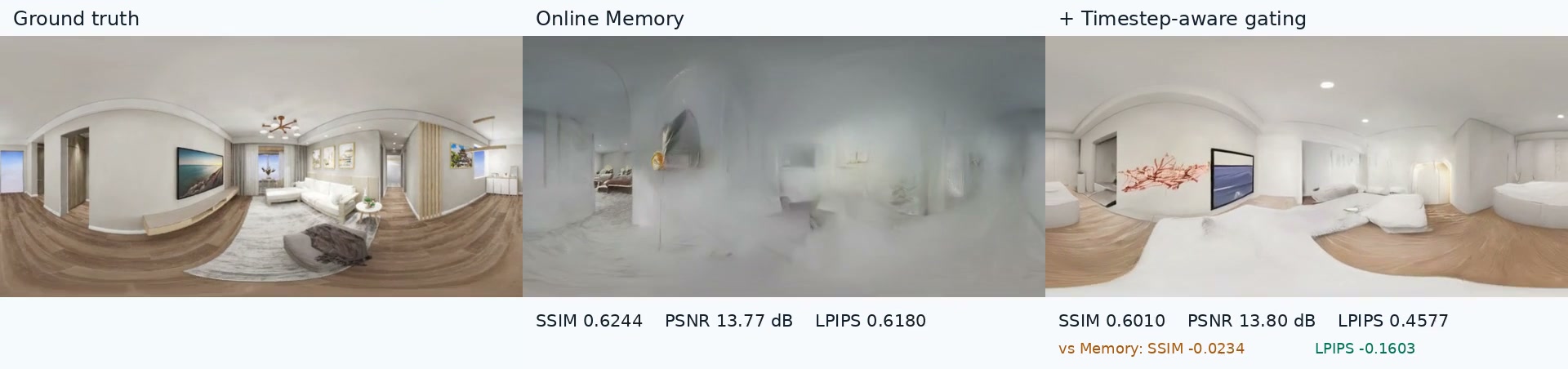
Gating retains more recognizable scene content and improves LPIPS, yet the smoother Online Memory output receives higher SSIM.
1.2 Controlled Blur Diagnostic
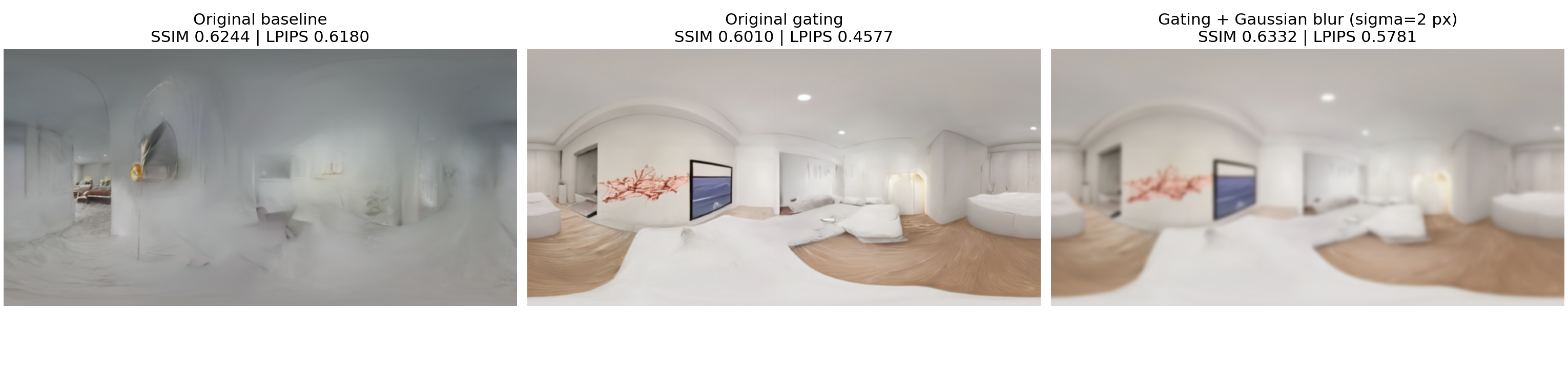
We take the Gating output frame shown in Fig. 1 and apply Gaussian blur (σ = 2 px) directly to the generated image as a post-processing step. Comparing this blurred image with the same ground-truth reference raises SSIM from 0.6010 to 0.6332, while worsening LPIPS from 0.4577 to 0.5781.
1.3 Full-sequence Comparison
| Method | SSIM ↑ | PSNR ↑ | LPIPS ↓ |
|---|---|---|---|
| Online Memory | 0.6421 | 15.36 | 0.5139 |
| + Timestep-aware Gating | 0.6287 | 16.05 | 0.4255 |
Across all 641 frames, gating improves PSNR and LPIPS, while SSIM drops. Fig. 1 and Fig. 2 illustrate how smoothing can favor SSIM despite losing perceptual detail.
Section 2. Long-horizon Quality over 16 Segments
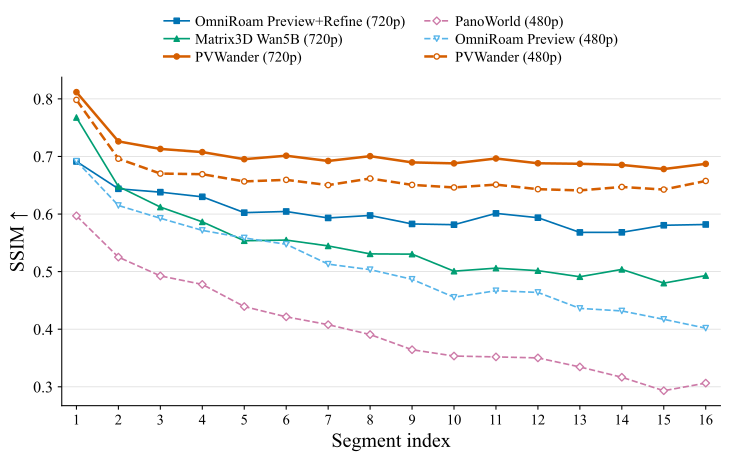
Segment-wise scores averaged over the same 20 scenes. Each point summarizes one segment: 81 frames for segment 1, then 80 new frames per segment.
2.1 Segment-wise SSIM
2.2 Segment-wise PSNR
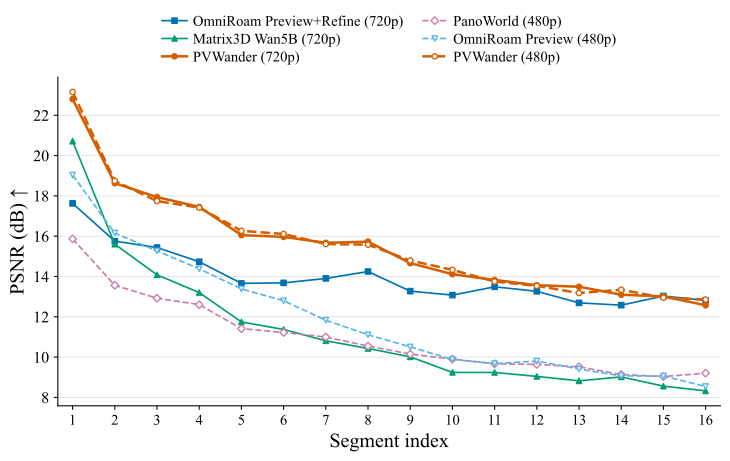
Shared boundary frames are counted once.